
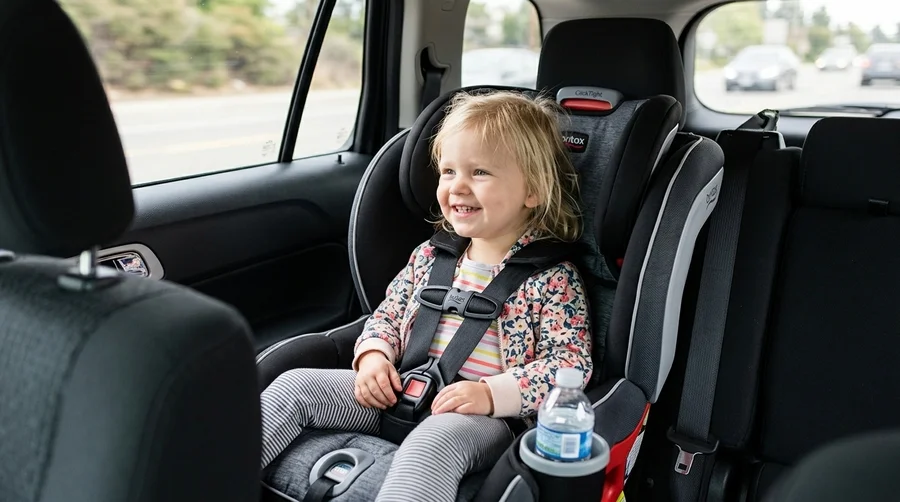
Is Your Child’s Car Seat Actually Legal? What Arizona Parents Need to Know
Most parents buying a car seat do their homework. They read reviews, check crash ratings, and make sure the seat fits their car. What few parents do is check whether their setup actually meets Arizona law, and whether the law is doing enough to keep their child safe.
Those are two different questions. Arizona’s requirements set a legal floor. Best practices for child passenger safety sit higher than that floor in several areas. Understanding both matters, because a crash does not care which one you followed.
What Arizona Law Actually Requires
Arizona’s child restraint law is governed by A.R.S. § 28-907. The rules break down by age and height, and both thresholds matter. A child must meet both criteria before moving to the next stage. Passing one does not automatically qualify them for the next. When accidents happen and children are injured, attorneys will look closely at Arizona’s booster seat laws to determine whether the child was in the correct restraint, because that can directly affect how a claim is evaluated.
Here is how the law is structured:
- Under 5 years old: Must be in an approved child restraint system at all times. No exceptions based on size or perceived maturity.
- Ages 5 to 7: Must be in a booster seat if shorter than 4 feet 9 inches. Both the age threshold and the height threshold apply.
- Age 8 and taller than 4’9″: Can use a standard vehicle seat belt without a booster, provided the belt fits correctly.
- Under 16: Must wear a seat belt regardless of where they are seated in the vehicle.
The fine for a violation is $50, though it can be waived if the driver subsequently purchases and installs the correct restraint and shows proof to the court. It is a low penalty relative to the stakes, which is worth keeping in mind when thinking about how seriously enforcement treats this issue.
The Detail That Trips Parents Up: Both Conditions Must Be Met
The most common misreading of Arizona’s law is treating age and height as either/or. They are not. A child who turns 8 but is still under 4 feet 9 inches is still required to be in a booster seat. A child who hits 4’9″ before age 8 technically meets the height requirement, but the age requirement still applies.
In practice, this catches families off guard at the age-8 birthday. Parents assume the booster seat is no longer needed because their child has had a birthday. If the child has not yet reached 4’9″, the law still requires the booster. Arizona is explicit on this: both thresholds must be cleared before a child moves to a seat belt only.
This two-part rule exists for a reason. Standard vehicle seat belts are designed for people at least 4’9″ tall. Below that height, the shoulder belt crosses the neck instead of the chest, and the lap belt rides across the soft abdomen instead of the hips. In a crash, that misalignment can cause serious internal injuries, sometimes more severe than the collision itself would have produced with a properly fitting belt.
Where the Law Ends and Safety Begins
Legal compliance and optimal safety do not always line up. There are several areas where following the law to the letter leaves room for improvement.
Rear-facing seats: Arizona law requires rear-facing positioning until age 1 and 20 pounds. The American Academy of Pediatrics recommends keeping children rear-facing until they reach the maximum height or weight limit of their specific seat, which for most convertible seats is well past age 2. Rear-facing spreads crash forces across the entire back, head, and neck rather than concentrating them on the harness contact points.
Front seat age: Arizona law does not set a minimum age for riding in the front seat, but it does prohibit children under 12 from sitting in front of an active airbag. Safety experts consistently recommend keeping children in the back seat until at least age 13. Front passenger airbags deploy with significant force and are calibrated for adult bodies.
Booster seat graduation: The law allows a child to use a seat belt once they are 8 and 4’9″. Safety organizations recommend keeping children in a booster until the vehicle’s seat belt fits correctly without assistance, which for some children means staying in the booster past the legal minimum. The belt test: lap belt low across the upper thighs (not the stomach), shoulder belt across the chest and collarbone (not the neck), and the child sitting all the way back against the seat with knees bent at the edge.
Installation Errors Are More Common Than Most Parents Realize
Having the right seat is only part of the equation. Studies have estimated that more than 85% of car seats are installed, placed, or used incorrectly in some way. The errors range from minor to significant, and some of them matter a great deal in a crash.
The most common installation and usage mistakes include:
- Loose installation: A properly installed seat should not move more than one inch side to side or front to back when tested at the belt path. More movement than that means the seat can shift in a crash.
- Harness straps too loose: The pinch test applies here. At the collarbone, you should not be able to pinch any slack in the harness between your fingers. A loose harness allows the child to move too far forward before the seat absorbs the impact.
- Chest clip positioned too low: The chest clip belongs at armpit level, not on the stomach. A low chest clip does not restrain the upper body effectively and can cause abdominal injury.
- Seat angled incorrectly: Rear-facing seats have angle indicators for a reason. Too upright, and a child’s head can flop forward. Most seats include an angle adjuster and a level indicator.
- Using a seat after a crash: Most manufacturers recommend replacing a car seat after any moderate or severe crash, even if the seat looks undamaged. The structural integrity may be compromised in ways that are not visible.
Many local fire stations and police departments in Arizona offer free car seat inspections. The Child Safety Seat Hotline at 602-543-8687 can direct you to an inspection site near you.
What Happens in a Crash If the Seat is Wrong
The consequences of an improperly used car seat go beyond the physical danger to the child. They can also affect a family’s legal position after an accident.
Arizona follows pure comparative fault rules. If a child was not properly restrained at the time of a crash, an insurance company or defense attorney can argue that the severity of the child’s injuries was increased by that failure. Under comparative fault, any percentage of fault assigned to the injured party reduces the compensation they can recover. A child riding without a required booster seat, or in a seat installed incorrectly, gives the opposing side a meaningful argument to reduce the payout.
This does not mean families lose their right to compensation entirely. It does mean that compliance with car seat law and adherence to safety best practices beyond what the law requires directly protects a family’s legal position in addition to their child’s physical safety.
Also Read:
- Why Do So Many Americans Believe That Car Payments Are Just a Normal Way of Life?
- Ford Recalls Hundreds of Thousands of Maverick Pickup Trucks
- Brittany Johns Car Accident
A Practical Checklist Before Every Trip
None of this requires expertise. It requires habit. Before putting a child in the car, run through these basics:
- Is the child in the right type of seat for their current age and height?
- Is the seat installed tightly enough that it does not shift more than an inch?
- Are the harness straps snug, with no slack at the collarbone?
- Is the chest clip at armpit level?
- For rear-facing seats, is the angle within the manufacturer’s recommended range?
Arizona’s car seat law exists because the data on child passenger fatalities is unambiguous. Used correctly, car seats reduce the risk of fatal injury by up to 71% for infants and 54% for toddlers, according to NHTSA. The law sets the minimum. The seat, installed and used correctly, does the actual work.


