
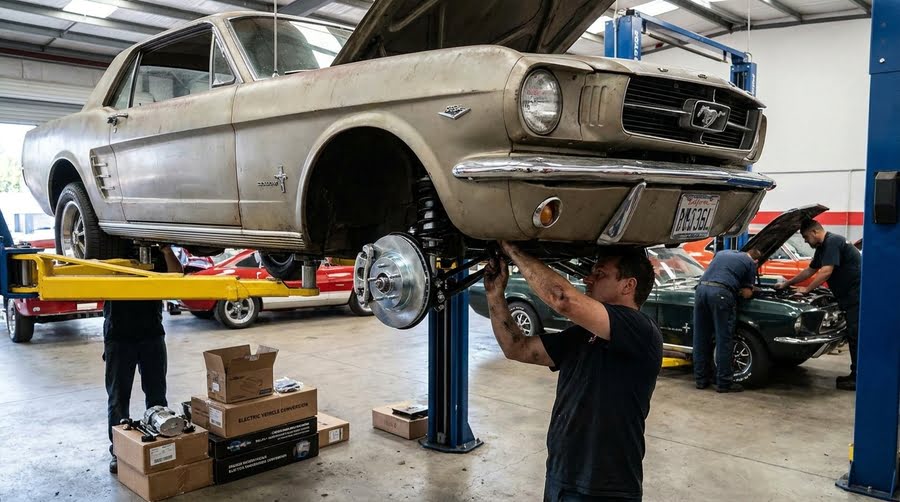
Why Classic Car Owners Are Upgrading What’s Underneath Instead of What Shows
There’s a quiet shift happening in the classic car world. A decade ago, the holy grail was factory-perfect restoration, every bolt and bracket exactly as it left the assembly line. Today, more builders are chasing something different: a car that looks like 1969 but drives like it belongs in modern traffic. The restomod movement has matured, and it’s changed what enthusiasts spend their money on.
The paint and chrome still get the compliments at the car show. But the smart money now goes into performance car parts that transform how these machines actually behave on the road: brakes, steering, suspension, and chassis components.
The Problem With Driving a Time Capsule
Anyone who has daily-driven a stock classic knows the truth behind the nostalgia. Four-wheel drum brakes that fade after two hard stops. Steering with enough play to change lanes before the wheels notice. Suspension that wallows through corners and crashes over potholes. These cars were engineered for the roads, speeds, and traffic of their era, and that era had no eight-lane freeways full of crossovers braking abruptly at 75 mph.
That’s the honest case for upgrading. It’s not about betraying originality. It’s about safety and usability. A classic that stops, steers, and handles predictably is a classic that gets driven instead of trailered, and cars that get driven are the ones that stay alive.
Where Upgrades Deliver the Most
Brakes come first. A front disc brake conversion is widely considered the single most transformative upgrade for any drum-braked classic. Modern rotors, calipers, a dual-chamber master cylinder, and a power booster turn white-knuckle stops into non-events. Complete conversion kits now exist for most popular applications, from Tri-Five Chevys and C10 trucks to first-generation Mustangs and Mopar B-bodies.
Steering is the second revelation. Power steering conversions and modern gear boxes eliminate the vague, heavy feel that makes old cars exhausting. Many owners describe the difference as rediscovering their own car.
Suspension ties it together. Tubular control arms, coilovers, sway bars, and updated springs sharpen handling and improve ride quality at the same time, a combination the factory setups rarely managed. For trucks, lowering kits and trailing arms add stance along with substance.
Chassis stiffening is the sleeper pick. Subframe connectors and reinforced crossmembers reduce flex, which makes every other upgrade work better.
Bolt-On Beats Fabrication
The biggest change in this market isn’t the parts themselves; it’s the fitment. The current generation of vehicle-specific kits is engineered to install using factory mounting points, no cutting or custom fabrication required. That matters for two reasons. Weekend builders with hand tools can now do work that once required a specialty shop, and the modifications remain reversible for anyone who someday wants to return to stock.
When shopping, favor vehicle-specific kits over universal parts, check that components within a system are matched (a big brake kit needs a properly matched master cylinder and proportioning valve), and look for suppliers with real tech support. A parts vendor who can answer fitment questions by phone is worth more than a marginally cheaper listing with no one behind it.
The Payoff
A well-sorted restomod does something no garage queen can: it turns every errand into an event. The exhaust note, the vintage lines, the thumbs-up at stoplights, all with braking and handling you can trust. Upgrading the parts nobody sees is how classic cars stop being museum pieces and get back to doing what they were built for, which is being driven.


